Best Employee Wellbeing Platforms UK (2026) — Compared & Ranked


UK workers lost an average of 4.4 days to sickness absence in 2025, unchanged from 2024, according to the Office for National Statistics. Deloitte estimates that poor mental health costs UK employers £51 billion a year. Employers should therefore choose an employee wellbeing platform based on the result they need. Focused products address needs such as therapy, fitness or mindfulness, while preventative whole-person platforms assess several dimensions of workforce health. Champion Health takes the latter approach.
The three types of platform
This guide groups platforms by their primary purpose, although individual products may offer features across more than one category.
- Mental health platforms focus primarily on mental health support. Examples covered in this guide include Unmind and Spill.
- Engagement and content platforms provide content, rewards or access to services intended to encourage participation. Examples include Wellhub, YuLife, JAAQ at Work, Headspace and Calm.
- Preventative whole-person platforms assess health across the workforce and report patterns in health data over time. Champion Health is designed as a preventative whole-person platform.
Start by matching the platform category to the outcome you need, then compare products on evidence, delivery model and ongoing participation.
Comparison: UK employee wellbeing platforms in 2026
This non-exhaustive comparison groups each platform by its primary purpose and the capabilities described by its provider. Product features can change, so buyers should confirm current coverage, reporting and clinical services directly with each provider.
Platform-by-platform guide
The profiles below explain the problem each platform is primarily designed to solve, the information it reports and the situations in which buyers may need broader coverage.
Champion Health
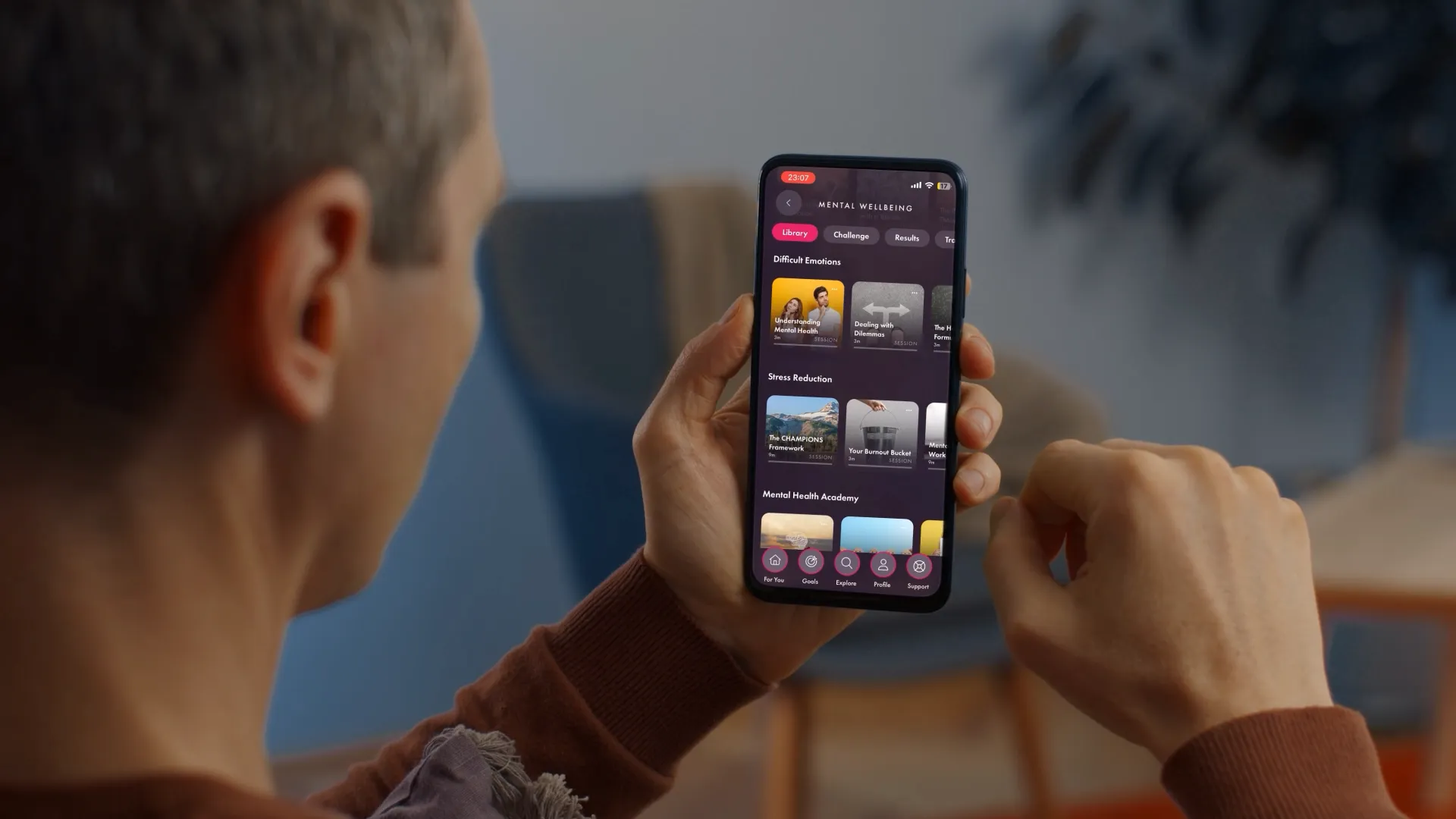
At Champion Health, we combine assessments of financial, mental and physical health in one preventative whole-person platform. During a 90-day workforce assessment, we aggregate employee health responses and compare results across departments to identify patterns in mental health and musculoskeletal risk. We then provide personalised self-management pathways and referrals to care when needed.
With Champion Health, employers can use our population-level analytics to identify patterns that may contribute to absence. Our coverage may be broader than a buyer needs when the requirement is a single-purpose benefit. Champion Health suits employers that want to measure workforce risk and use that data to reduce absence.
Champion Health's internal reporting cites an average 8% reduction in absenteeism and says that 94% of surveyed employees reported a positive impact. Its model estimates an annual absence saving of £80,000 for an organisation with 1,000 employees. These figures are not directly comparable without details of the sample, measurement period, engagement benchmark and model assumptions. Buyers should request that information from every provider.
Employer reports contain aggregated, confidential data. Champion Health states that it does not sell individual employee information or disclose it to employers. Buyers should review its current privacy notice, aggregation thresholds and data-processing terms as part of their due diligence.
Unmind
Unmind specialises in clinical mental health support and provides employers with reporting on use of its mental health services. Its focus on mental health suits employers that want to improve support and participation.
Employers seeking physical, musculoskeletal or financial health services should confirm whether Unmind's current product coverage meets those requirements. Unmind is less suitable if you need workforce-wide risk data across several dimensions of health, but it fits a clinical mental health priority.
Spill
Spill embeds mental health support and therapy into workplace tools such as Slack and Teams. Employees can access support through tools they already use, which reduces the effort required to find help. Usage metrics show whether employees use the service.
Spill reports use of its chat-based service rather than whole-workforce risk, and it does not assess health beyond mental health. Spill suits employers that want accessible therapy within everyday communication tools.
Wellhub
Wellhub is a fitness marketplace that gives employees access to gyms and other fitness services. Wellhub gives employers activity data to track participation in physical wellbeing benefits.
Although Wellhub provides mental health support through apps, its primary purpose is not to assess workforce-wide health patterns or provide financial wellbeing insight, and clinical care is not its primary focus. Wellhub suits employers whose main goal is gym and fitness engagement.
YuLife
YuLife combines life insurance with gamified wellbeing, using activity rewards and engagement metrics to encourage day-to-day participation.
YuLife centres on insurance and activity rewards rather than musculoskeletal risk assessment. Employers should confirm the mental health services included in the current product. YuLife's reporting covers insurance and engagement data. YuLife suits employers that want to bundle life cover with a wellbeing benefit.
JAAQ at Work
JAAQ at Work delivers on-demand video content across wellbeing topics. It can support employee awareness alongside an existing employee assistance programme.
JAAQ at Work's content can inform employees, but content engagement is not a substitute for an individual health assessment or aggregated workforce-risk analysis. The platform reports engagement rather than providing an integrated health assessment. It suits employers that need awareness and education rather than preventative analytics.
Headspace and Calm
Headspace and Calm provide app-based mindfulness content, particularly for stress and sleep. Employers can add these self-directed apps when they want to provide mindfulness tools without introducing a broader health assessment.
They do not assess physical or financial health, and app engagement does not provide the same insight as population-level workforce risk analytics. Headspace is best suited to employers seeking guided mindfulness and mental health content. Calm is best suited to employers seeking self-directed content for meditation, relaxation and sleep. Buyers should compare their current employer reporting and support services separately.
How to choose an employee wellbeing platform
- Define the primary result you need. Decide whether you want to reduce absence or address a narrower wellbeing need. Your goal helps identify the relevant platform category before you compare products.
- Establish your baseline. Record the measures you want to change, such as absence or participation. Ask each provider how its reports will measure progress against that starting point instead of relying on a feature list.
- Decide which employees the platform must reach. Look beyond initial sign-ups and ask providers to report continued use after launch at clearly defined intervals. Compare delivery models based on whether they can reach employees who rarely use existing wellbeing benefits.
- Assess the available HR resource. Some services provide a focused employee benefit, while others require you to interpret workforce data and act on it. Assign responsibility for reviewing reports and acting on the findings.
- Compare the evidence behind the promised result. Ask providers for the measurement period, sample size and definition behind claims about engagement, health improvement or absence reduction. Give greater weight to evidence tied to your chosen outcome than to total sign-ups or feature counts.
Before buying, ask whether the platform can track changes in relevant health indicators before and after launch and whether employees will continue to use it after launch.
FAQs
What is the best employee wellbeing platform in the UK?
Champion Health is best for employers seeking whole-person workforce assessment and aggregated risk reporting. Unmind and Spill are better suited to a mental health priority, Wellhub to fitness access, YuLife to insurance with activity rewards, JAAQ at Work to educational content, and Headspace or Calm to mindfulness and sleep support. Champion Health is designed for employers that want to measure whole-person workforce risk and use the findings to reduce absence. Matching the platform to the outcome helps employers avoid paying for a broad service when they need a focused benefit, or choosing a narrow app when they need workforce analytics.
What is the difference between an employee wellbeing platform and a wellbeing app?
A wellbeing app usually gives individuals content or tools for a focused need, while a platform may also assess workforce needs and provide employer-level reporting. Champion Health combines employee assessments and care pathways with aggregated workforce insights. This distinction helps employers choose between offering a standalone benefit and managing health risk across the organisation.
What participation rate should an employer expect?
A credible participation benchmark must define the eligible population, the action counted and the measurement period. Ask each provider for participation at launch and at later intervals, along with the benchmark used for comparison. These definitions matter more than a headline percentage because registration, assessment completion and continued service use measure different behaviours.
Do employee wellbeing platforms reduce absence?
Employee wellbeing platforms can contribute to lower absence, but a before-and-after change does not by itself prove that the platform caused it. Champion Health’s internal reporting cites an average 8% reduction in absenteeism and estimates an annual saving of £80,000 for a 1,000-person organisation. Establishing a baseline and reviewing the provider’s methodology helps employers judge whether an improvement is credible and relevant to their workforce.
What are the main alternatives to Champion Health?
The alternatives covered in this comparison are Unmind and Spill for mental health support, Wellhub for fitness access, YuLife for insurance and activity rewards, JAAQ at Work for educational content, and Headspace and Calm for mindfulness support. Champion Health differs by combining financial, mental and physical health assessment with aggregated workforce-risk reporting. Understanding these categories helps employers select a focused benefit for a narrow requirement or a whole-person platform for broader prevention.
How is Champion Health different from a mental health app?
A mental health app primarily supports one dimension of employee wellbeing through content, tools or clinical services. Champion Health combines financial, mental and musculoskeletal assessments with aggregated employer reporting and pathways into care when needed. This broader view helps employers identify related risks across the workforce rather than relying only on app-usage data.
Does Champion Health share employee data with employers?
Aggregated workforce data combines employee responses so employer reports do not identify individual participants. Champion Health provides employers with confidential aggregate insights and does not sell or disclose individual employee information to them, in line with GDPR. This approach allows employers to identify workforce-level patterns while protecting employee privacy.
Is there a free version of Champion Health?
Champion Health offers a 90-day workforce assessment that employers can access without a paid contract. The assessment lets employers evaluate Champion Health's whole-person assessment and aggregated reporting before considering a longer-term service. Employers should confirm the current eligibility, scope and terms with Champion Health.
See where risk is building in your workforce
Choose a platform by starting with the outcome you need, establishing a baseline and checking whether the provider can connect its evidence to that result. Learn more about Champion Health's 90-day workforce assessment and how it reports aggregated patterns across mental, physical and financial health.